Mendoza and Cuyo
Backed by the Andes, the region concentrates 75% of Argentina's vineyards, the ascent of Aconcagua and the desert landscapes of Ischigualasto and Talampaya.
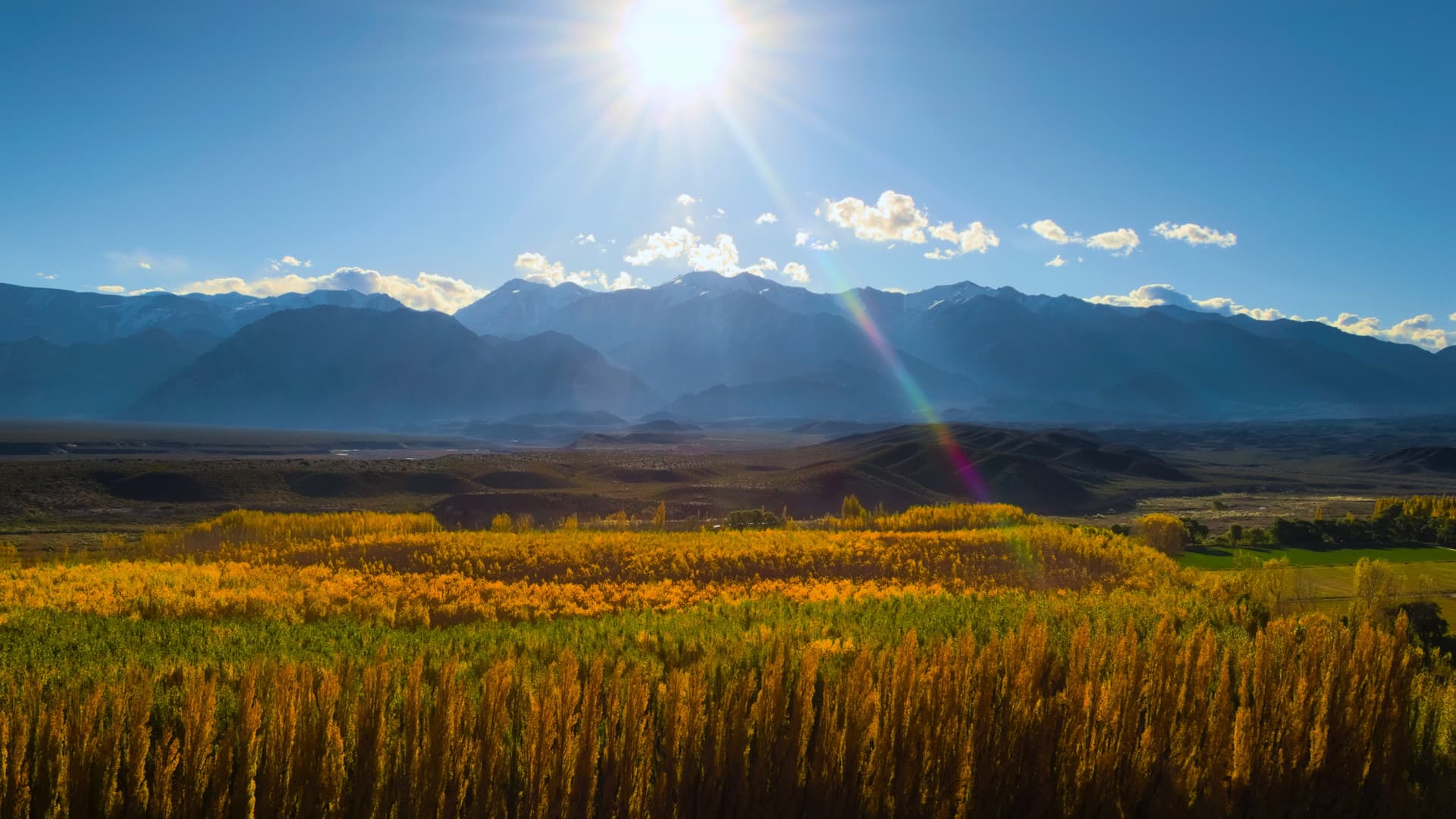
Mendoza and Cuyo cover an arid strip backed by the Andes cordillera, spanning the provinces of Mendoza, San Juan and La Rioja. Our local agency operates primarily from the city of Mendoza, 1,050 km west of Buenos Aires, the logical entry point to the region with its international El Plumerillo airport. Contrast defines everything here: to the east, the semi-desert foothills where nothing would grow without irrigation; to the west, the snow-capped peaks of the pre-cordillera and then the main cordillera, dominated by Aconcagua at 6,962 m. Between the two, vineyards occupy terrains developed since the late 19th century by Italian and Spanish immigrants.
Argentina's wine region lies here. Mendoza produces roughly 75% of the country's wine, and malbec, a varietal from Cahors, has found its ideal expression: alluvial soils, low rainfall (200 mm annually), day-to-night temperature swings of 15 to 20 °C during the season. Three zones are worth visiting: Luján de Cuyo and Maipú, on the immediate outskirts of the city, perfect for a day cycling between wineries; and Uco Valley, 1.5 hours south, between 1,000 and 1,500 m altitude, where wines gain tension and freshness. The villages of Tupungato, Tunuyán and San Carlos serve as bases for exploring this valley.
Beyond wine, the region offers serious mountaineering terrain. Quebrada del Condor and Aconcagua provincial park connect via Route 7, an international highway that crosses the cordillera at Cristo Redentor Pass (3,832 m) before dropping into Chile. The stretch between Uspallata and Puente del Inca, a former thermal resort with orange mineral concretions, traverses high-altitude landscapes reminiscent of the Altiplano. Further south, San Rafael provides access to Cañón del Atuel, a gorge carved by the river of the same name, and whitewater rafting runs ranging from Class II to IV depending on the season.
San Juan and La Rioja round out the region with two less-visited sites: Ischigualasto national park, nicknamed Valle de la Luna for its grey sedimentary formations and Triassic fossils, and Talampaya national park, whose red cliffs reach 150 m. Both can be visited on a circuit from San Juan—budget two full days to do them justice. The road between Mendoza and San Juan, some 170 km, crosses the Pedernal wine basin, currently experiencing qualitative growth.
On the food front, you'll find more goat meat (chivito) here than elsewhere in Argentina, particularly around Malargüe and southern Mendoza. Mendoza empanadas are baked and include whole olives. The Harvest Festival, Fiesta Nacional de la Vendimia, takes place in early March in Mendoza: neighbourhood parades, queen elections, and evening performances at the Frank Romero Day Greek Theatre. It's the liveliest time of year, but also peak accommodation season.
Cuyo also embodies a culture of time and depth. The inhabitants, cuyanos, share little with Buenos Aires porteños: more rural, more Andean in music (cueca, tonada), oriented toward Chile as much as toward eastern Argentina. Our English-speaking guides emphasize this point: coming here solely for malbec would mean missing half of what the region offers.
Must-See
Uco Valley and high-altitude wineries. Day trip between Tupungato and San Carlos, at 1,000–1,500 m, tastings at estates like Salentein or Andeluna, direct views of Tupungato at 6,570 m from the vines.
Cristo Redentor Route toward Aconcagua. Drive up Route 7 to the provincial park: stop at Puente del Inca, hike to Laguna de los Horcones overlooking Aconcagua's south face, return to Mendoza the same day.
Ischigualasto and Talampaya. Two days in the San Juan and La Rioja parks, sedimentary formations dating to the Triassic, red cliffs explored by 4x4 and on-foot access to Garganta del Cañón.
Fiesta de la Vendimia in Mendoza. First week of March, performance at the Greek Theatre, processions through wine-producing departments, accommodation to be booked six months in advance during this period.
Rafting on the Río Mendoza or Río Atuel. Class II to IV runs depending on water flow, more challenging between November and January during snowmelt. Half-day trips departing from Potrerillos or San Rafael.
When to Visit
The best window runs from October to April. Southern spring (October–November) offers mild temperatures, 22 to 26 °C during the day in Mendoza, almond and cherry blossoms in Uco Valley, and Andean passes already reopened. Summer (December–February) is hot and dry, 30 to 35 °C in the lowlands, but nights remain cool at altitude. March coincides with the harvest and Fiesta de la Vendimia, the busiest period for wine tourism and visitor numbers. Autumn (April–May) remains pleasant, with copper-coloured vineyard foliage and temperatures of 18 to 22 °C.
Winter (June to September) requires greater caution. Rainfall remains minimal, around 10 mm monthly, and clear skies often deliver excellent views of the snow-capped Andes. However, the Cristo Redentor Pass toward Chile closes regularly after snowfall, sometimes for several days at a stretch, and climbing Aconcagua is not feasible. Temperatures in Mendoza drop to 3–12 °C, and far lower at altitude. It's a good season for winery visits and skiing at Las Leñas or Penitentes, but not for ambitious mountain programmes.
Practical Tips
Allow a minimum of 4 days for Mendoza and Uco Valley, 6 to 7 days to include high mountain terrain (Aconcagua, Puente del Inca) and a foray to San Rafael or the San Juan and La Rioja parks. Access is by direct flight from Buenos Aires, 1 hour 50 minutes, with several daily frequencies. Car rental is useful for Uco Valley and Route 7; otherwise we arrange driver transfers, allowing you to taste without constraint.
The region combines beautifully with the north-west Andes via a Mendoza–Salta flight (2 hours 10 minutes), extending the high-altitude landscape and vineyard theme, with Cafayate wines taking over. Connections to the Lake District of Patagonia (Bariloche) are also by air. Linking with Buenos Aires remains the most natural choice at the start or end of your stay. Hotel comfort ranges from charming posadas nestled in vineyards to contemporary lodges in Uco Valley, with marked upgrades over the past decade. Cuyo suits wine enthusiasts, hikers and couples seeking a relaxed pace between tastings and day excursions particularly well. Families with children also find plenty to enjoy: rafting, horseriding and condor-watching.