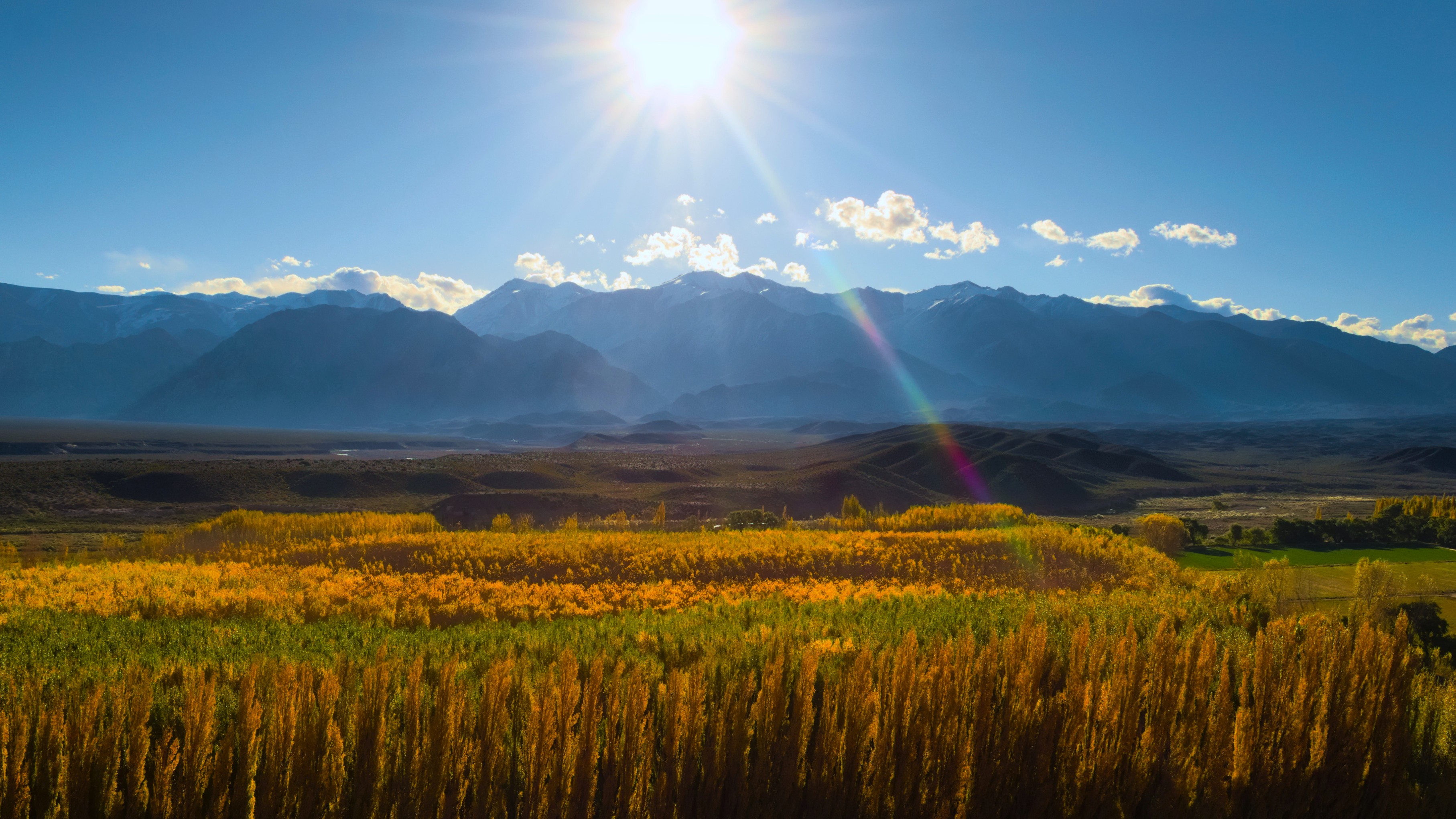
Southern Patagonia
Hielo Continental glaciers, Fitz Roy granite peaks and Ushuaia port on the Beagle Channel: the country's southern tip takes a minimum of 7 days to explore, domestic flights essential.
Southern Patagonia covers the extreme south of the country, between Santa Cruz province and Tierra del Fuego. It is a region of windswept steppes, granite massifs and continental ice fields, the Hielo Continental Sur, the world's third-largest reserve of frozen freshwater after Antarctica and Greenland. Our team treats it as technical terrain: distances of 200 to 400 km between points of interest, domestic flights from Buenos Aires almost always necessary, and weather conditions that dictate the programme day by day.
El Calafate, on the southern shore of Lago Argentino, is the gateway to Los Glaciares National Park. The Perito Moreno glacier, 80 km from the city, presents a 5 km-wide front and 60 m high above water, visible from a network of metal walkways spread across three levels. It is one of the few glaciers in mass balance, which explains the regular calvings heard from the observation decks. Further north in the same park, El Chaltén is a village founded in 1985 for border reasons, which became the departure base for treks to Fitz Roy (3,405 m) and Cerro Torre. The walk to Laguna de los Tres takes 8 to 10 hours return with a final elevation gain of 400 m over scree; the Mirador Maestri route to Torre remains more accessible as a half-day hike.
At the far south, Ushuaia spreads across Beagle Channel bay, framed by the last foothills of the Andes cordillera which collapses here into the Atlantic. The city has 80,000 inhabitants and lives from fishing, free-trade electronics, and polar tourism. It is the departure port for nearly all cruises to the Antarctic Peninsula, from November to March, as well as short navigations on the Beagle to observe sea lions, imperial cormorants and the Les Éclaireurs lighthouse. Tierra del Fuego National Park, 12 km to the west, offers seaside trails through the subantarctic forest of lengas and ñires.
Southern Patagonian culture developed late, from the end of the 19th century, with the arrival of Welsh, German and Croatian estancieros who came to raise merino sheep on vast properties. Many of these estancias still exist around El Calafate and Río Gallegos, sometimes open to travellers for overnight stays or an asado de cordero al palo lunch, lamb split open and roasted for 4 hours on an iron cross facing hot coals. The original peoples, Tehuelches on the steppe and Yámanas on the Beagle Channel, were largely decimated at the turn of the 20th century; the Museo del Fin del Mundo and Museo Marítimo in Ushuaia, housed in the former penitentiary, document this history.
Geography sets the pace. Between El Calafate and El Chaltén, allow 3 hours by road along Route 40 beside Lago Viedma. Between El Calafate and Ushuaia, no direct road route is practical without passing through Chilean territory; we therefore favour flying via Río Gallegos or Buenos Aires, which costs half a day. This logistical constraint is the main reason we rarely recommend southern Patagonia for less than 7 days on the ground.
Highlights
Perito Moreno glacier front from the walkways. Three hours on the observation decks facing the glacier is enough to hear internal cracking and see one or two calvings fall into the Témpanos channel. Optional navigation at the foot of the north wall.
Laguna de los Tres trek. 22 km return walk from El Chaltén to the glacial lake beneath the east face of Fitz Roy. The last two hours climb a steep scree cone; set out before 8 am to avoid afternoon winds.
Beagle Channel and Les Éclaireurs lighthouse. 4-hour navigation from Ushuaia port between islets with Magellanic sea lions, cormorant colonies and the red and white cylindrical lighthouse built in 1920.
Night at a Patagonian estancia. An overnight stay at Estancia Cristina or Nibepo Aike near El Calafate, accessible by boat or dirt track, to share an asado de cordero and watch herds of guanacos across the steppe.
Ushuaia penitentiary and the end of the world. The Museo Marítimo occupies the former military prison from 1902 whose radiating pavilions housed political prisoners and common criminals; 2-hour visit to understand how the city was born from penitentiary colonisation.
When to go
The operational window runs from October to April, with internal variations. November and December are the windiest months: frequent gusts of 80-100 km/h across the El Calafate steppe and around Fitz Roy, which can close summits to beginner hikers. January and February offer the mildest temperatures (15 to 22 °C daytime in El Calafate, 9 to 15 °C in Ushuaia) but it is Argentine peak season: park shelters saturated, accommodation to book 6 months in advance. March and early April are our preferred window, with early autumn colours on the lengas, calmer winds and visitor numbers halved.
From May to September, El Chaltén runs at a slower pace, many high-altitude trails are closed by snow, and navigations to Perito Moreno are reduced. Ushuaia, conversely, becomes a specific winter destination with skiing at Cerro Castor from June to October and temperatures between -5 and 5 °C. Antarctic cruises operate strictly from late October to late March.
Practical advice
We recommend a minimum of 7 days on the ground to combine El Calafate (2 nights), El Chaltén (3 nights if you want to do two treks) and Ushuaia (2 nights). Domestic flights from Buenos Aires serve El Calafate and Ushuaia airports; the direct link between the two exists but remains seasonal. Without flying, you must transit through Río Gallegos or the capital, which adds a day. Southern Patagonia logically combines with the Lake District Patagonia (Bariloche, San Martín de los Andes) for travellers with 12 to 15 days, or with Peninsula Valdés in September-October for southern right whale watching before heading down to the glaciers.
Comfort levels are good across the three bases: 4-star hotels in El Calafate and Ushuaia, high-end lodges and estancias around the parks. El Chaltén remains more rustic, with charming hosterías but few luxury options. The region suits hikers particularly well (marked trails from 2 to 12 hours), contemplatives who accept long driving distances for a few hours of scenery, and travellers preparing a polar cruise. Families with young children will find El Chaltén more demanding; we then recommend centering the stay on El Calafate and Perito Moreno.