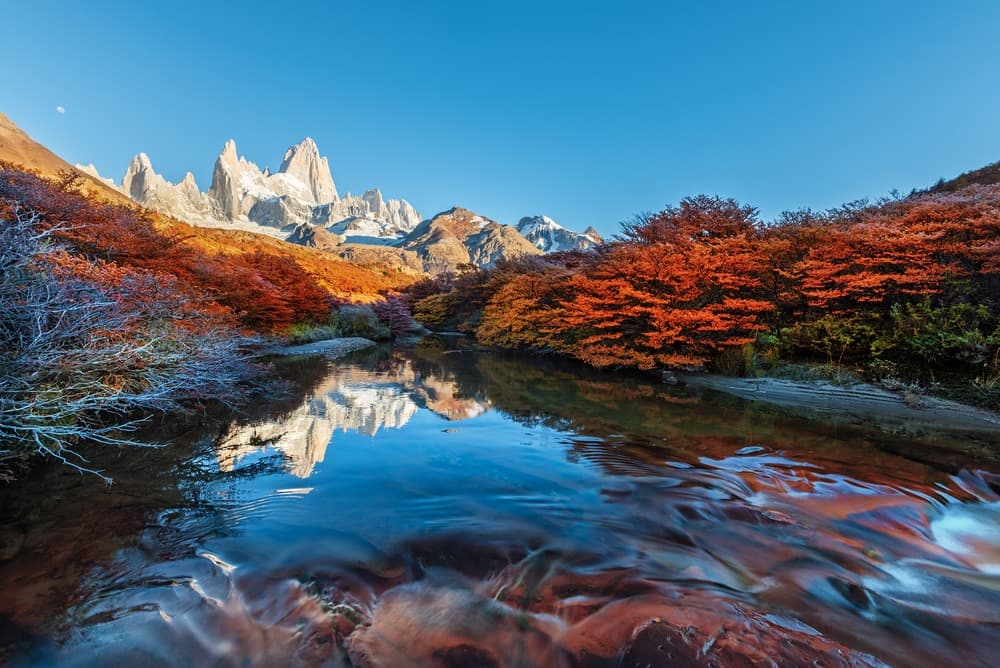
Fitz Roy
Fitz Roy
A granite summit standing 3,359 m above El Chaltén, Fitz Roy reveals itself through three major treks accessible without technical climbing gear.
Fitz Roy is one of the most emblematic summits of the Andes—and the world—renowned for its striking beauty and challenging access. Known to mountaineers everywhere, it also captivates trekkers and locals alike. Rising at the edge of a desert steppe, at 3,359 m elevation, towering above the village of El Chaltén, the majestic Fitz Roy peak creates one of Patagonia's most breathtaking landscapes.
The History of Fitz Roy
Fitz Roy was already familiar to the Tehuelche people, who inhabited the region before the Spanish arrived. Multiple archaeological finds attest to the presence of these indigenous peoples around the Lake Viedma, at the foot of Fitz Roy.
The Tehuelches first named Fitz Roy "Cerro Chaltén"—meaning "The Mountain That Smokes" in their language. This likely refers to the meteorological conditions: the summit is often shrouded in cotton-like clouds.
Westerners discovered the peak in 1782, when explorer Francisco de Biedma y Narváez reached Lake Viedma by following the Santa Cruz and Chalia rivers. After founding the city of Puerto San Julián, he organized an expedition to explore the interior lands of Patagonia. The Tehuelches showed him two mountains—remarkably visible and steep—with Chaltén being the highest.
A second expedition into this remote corner of Patagonia took place in 1834. It was led by Englishman Robert FitzRoy, who was then surveying South America aboard the HMS Beagle.
It was geographer Francisco Moreno who renamed the peak in 1877. Moreno's mission was to precisely demarcate the border between Chile and Argentina. After spotting the impressive Fitz Roy from a distance on February 14, he decided to name it in honor of Captain Robert FitzRoy from the previous expedition.
In the 1930s, Alberto María De Agostini, a missionary, undertook an exploration of the valleys surrounding Fitz Roy. He was the first to traverse the Southern Patagonian Ice Field.
As for Fitz Roy itself, it was first summited by French alpinists Lionel Terray and Guido Magnone in 1952. They began their ascent on January 31 and reached the peak on February 1 at 4:40 pm.
The north pillar of Mount Fitz Roy, whose extreme conditions make climbing particularly difficult, was conquered by Italian Renato Casarotto in 1979.
Fitz Roy Today
The Cerro Fitz Roy, also known as "Cerro Chaltén," is a magnificent peak near the village of El Chaltén in Patagonia. Standing among the Saint-Exupéry, Guillaumet, and Mermoz peaks, it rises above the snow-covered landscape of southern Patagonia.
It is bounded west to east by the ice field and the Río Eléctrico valley, and to the south by the Río Túnel valley. Having lent its name to the Fitz Roy massif, it stands 5 km northeast of Cerro Torre.
Fitz Roy is the emblem of the Patagonian region. The enduring fascination with this granite monolith stems from its steep pyramidal form, sculpted by harsh weather conditions.
Today, summiting Fitz Roy remains a feat of physical endurance and a true challenge for experienced mountaineers.
Fitz Roy: Coveted by Mountaineers and Climbers Worldwide
Fitz Roy reaches an elevation of 3,359 meters, in southern Argentine Patagonia. Its pyramidal form was carved 100 million years ago by the collision of vast tectonic plates. Since then, erosion from intense storms has given it its spellbinding jagged shape. Fitz Roy is composed primarily of magmatic rock deeply anchored in the earth.
Mountaineers from around the world know this impressive granite massif of the Andes cordillera. Its vertical walls rising above surrounding glaciers inspire dreamers everywhere. The renowned climber Alex Honnold even named his son after this peak.
Mount Fitz Roy overlooks the Southern Patagonian Ice Field, a vast glaciated region spanning 13,000 km² located largely on the Chilean side of Patagonia. The trekking zone is relatively compact, centered mainly around Cerro Torre (3,102 m) and Cerro Fitz Roy (3,359 m).
Flora is virtually nonexistent on these peaks. However, the gentler foothills are covered with low beech forests and vast plains with sparse vegetation. In these extreme climatic conditions, biodiversity is limited.
Fauna includes the long-tailed pygmy rice rat, Magellanic fox, eagle, and rabbits.
Fitz Roy: A Natural Gem of Argentine Patagonia
Fitz Roy is one of South America's most iconic mountains. Catching sight of it justifies a stay in El Chaltén, a small outpost at the edge of the Patagonian world.
This granite monolith forms part of the Los Glaciares National Park to the north and the Perito Moreno Glacier to the south. Set in an idyllic setting, its name stirs the imagination of trekkers and outdoor enthusiasts worldwide.
At once solemn, majestic, awe-inspiring, and mythic, Mount Fitz Roy stands as the highest point of the Fitz Roy massif, itself comprising two mountain ranges: the Fitz Roy range and the Cerro Torre range.
The granite needle of Mount Fitz Roy forms a spectacular panorama near the Viedma, Upsala, and Moyano glaciers. These glaciers feed into Lake Viedma, whose glacial blue waters stretch across 106,000 hectares.
Trekking Around Mount Fitz Roy
Mount Fitz Roy is one of the most impressive granite peaks adorning the Andes cordillera. Numerous trekking trails, several departing from El Chaltén, allow you to enjoy the landscape and superb views of Mount Fitz Roy (especially on clear days).
- The Laguna de Los Tres trail, at the foot of Cerro Fitz Roy, is among the finest treks in the area (6 hours round-trip to the Maestri viewpoint). From the south of El Chaltén, head toward "Los Loicas" street, then turn (at the red building) onto the left path. This leads toward residential areas. After crossing these homes, you arrive at the foot of a sandy hill to climb. The view of Fitz Roy and its snow-capped summit is breathtaking.
Along the way, you traverse pampa landscape with yellow-orange hues, forests, and wetlands (called "mallin" in Spanish). The sand adjacent to sparse yellow grass, dry wood, pure streams, shrubs, and boulders invite wanderlust and exploration.
- The trek to Laguna Torre is one of Patagonia's finest treks, offering exceptional panoramas of Cerro Torre. It's a hike with 650 meters of elevation gain. Spanning between 21 and 24 km, it can be completed in 6 or 7 hours. Like the trek to Laguna de Los Tres, it's essential for anyone wishing to explore this part of Argentina. The trailhead is located 1 km from El Chaltén's center.
The trail begins with a gentle climb through lengua forests, trees typical of the region. The soft green of the foliage is stunning. Crossing the banks of the Fitz Roy River, you reach Margarita Waterfall.
The hike continues up a steep moraine, leading to the Cerro Torre viewpoint. From this lookout, you contemplate Cerro Torre standing nearly vertical in the distance, crowned with its snow-capped "mushroom," as well as the Fitz Roy summit.
- By trekking the Loma del Pliegue Tumbado trail (8 to 10 hours round-trip), you'll experience one of the region's finest panoramic vistas.
The Best Time to Visit
Weather around Mount Fitz Roy is particularly unpredictable. As for temperatures, they can shift abruptly.
Generally, temperatures are cool and accompanied by powerful winds. The western face experiences significant precipitation coming from the Pacific Ocean. The eastern face, toward El Chaltén, sees relatively low rainfall, with rain in summer and snow in winter.
The best trekking season in the region runs from November to April, during the austral summer. Visiting Mount Fitz Roy in clear weather ensures optimal visibility.
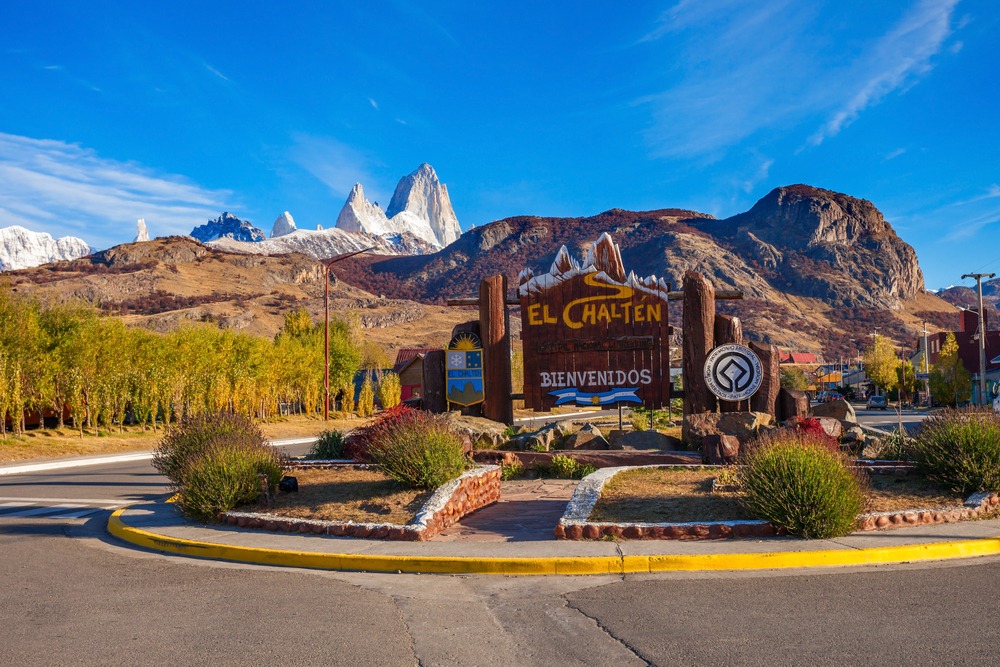
The village of El Chaltén is the gateway to Mount Fitz Roy.
By Air
Take an international flight to Buenos Aires, then a domestic flight to El Calafate. Next, take Route 40 via bus, taxi, or rental car to reach El Chaltén.
By Car
From the south or north, travel National Route (RN) 40 (215 km), then Provincial Route (RP) 23.
From the east, take RP 3, 288, 40, and 23.
By Bus
Several buses depart daily from El Calafate for Fitz Roy. Allow 3 hours of travel.
From Bariloche or the north, the bus travels the Ruta 40 (the legendary highway of the Argentine Andes). Expect 10 to 12 hours of travel time.
El Chaltén's bus terminal is located at the southern end of the village, just before the bridge.
Interested in this visit?
We can include it in your personalised itinerary.