Cerro de los Siete Colores
Cerro de los Siete Colores
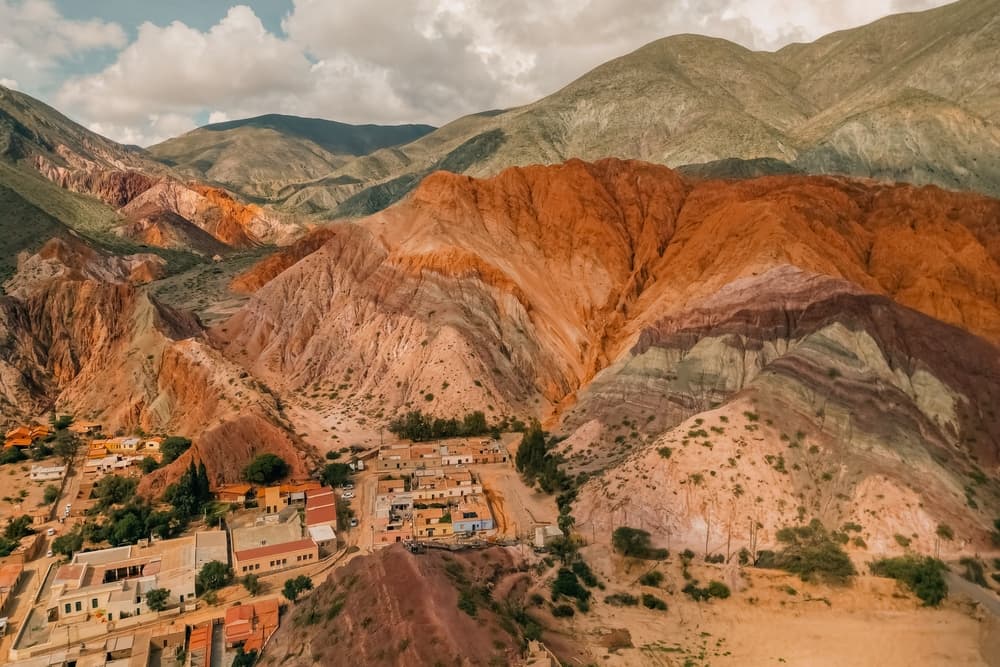
In Purmamarca, the Cerro de los Siete Colores displays seven geological hues—red, ochre, violet, green, yellow, white, gray—in the heart of the Quebrada de Humahuaca, a UNESCO World Heritage site.
The Cerro de los Siete Colores towers over the village of Purmamarca in the Quebrada de Humahuaca, northwestern Argentina. This mountain's polychromatic strata—red, ochre, violet, green, yellow, white, and gray—result from millions of years of sedimentation and volcanic activity. It ranks among the most spectacular geological landscapes of the Andean Puna and draws visitors worldwide drawn to its natural color richness.
Quick Practical Guide
- Access: the mountain is visible from the village itself; a hiking trail (Paseo de los Colorados) allows for a partial loop around it.
- Duration: 1 to 2 hours for the marked trail loop.
- Best time: early morning, when low-angle sunlight intensifies color contrasts.
- Altitude: Purmamarca sits at roughly 2,200 m; allow acclimatization time if arriving from lower elevations.
- Gear: hiking shoes recommended for the trail; hat and sunscreen essential.
What You'll See
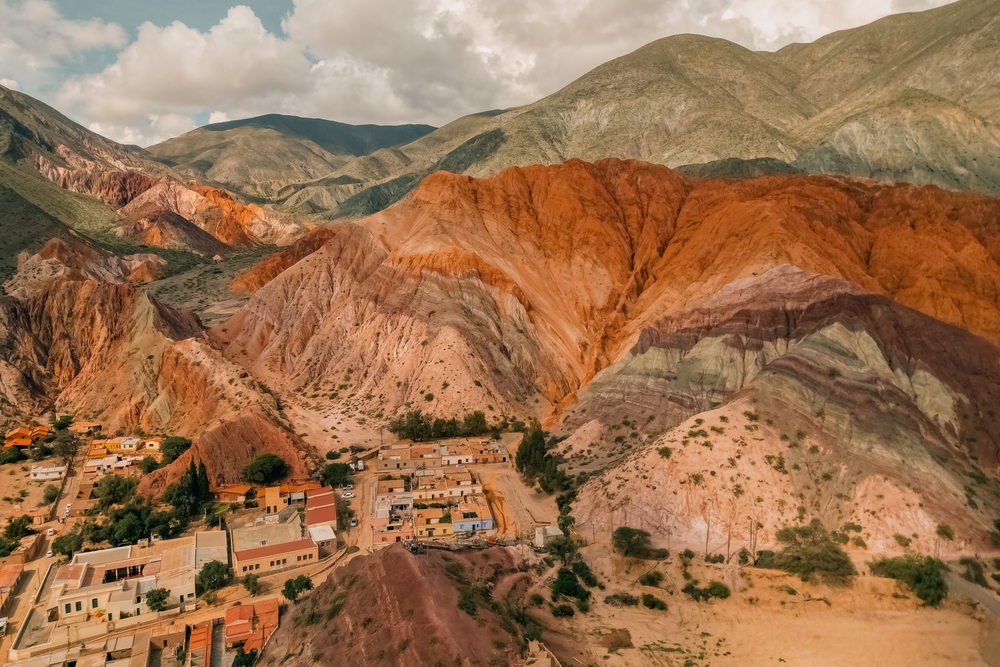
The mountain displays seven distinct hues depending on angle and daylight. Sedimentary strata, formed over 600 million years ago, alternate between red sandstone, white limestone, violet schist, and green clay. The village of Purmamarca, with its colonial church and artisan market, nestles at the foot of this colored wall, creating striking contrast between adobe architecture and geology.
History and Context
The Quebrada de Humahuaca, of which Purmamarca is part, was inscribed as a UNESCO World Heritage site in 2003. This Andean corridor served as a pre-Columbian and later colonial passage, linking high plateaus to plains. The Omaguaca and Atacameño peoples inhabited these valleys long before the Inca arrived, integrating the region into their empire in the 15th century. The mountain's colors held symbolic meaning in local Andean cosmologies.
Highlights of Your Visit
The Paseo de los Colorados
This marked trail partially loops the mountain, offering close views of the colored strata. The path crosses vegetation of cardones (candelabra cacti) and xerophytic shrubs typical of the Puna. As you progress, you'll notice how colors shift with sun exposure.
The View from the Main Plaza
Purmamarca's Plaza 9 de Julio offers the classic framing: the Santa Rosa church (17th century) in the foreground, the mountain beyond. From this angle, all seven colors are most visible to the naked eye.
The Artisan Market
Around the plaza, local artisans sell llama-wool textiles, ceramics, and silver jewelry. The market runs daily and offers direct entry into the region's Andean craftsmanship.
Photography Tips
Morning light (between 7 a.m. and 10 a.m.) is ideal: direct sun illuminates the rock face and colors pop without harsh shadows. Midday overhead light flattens contrasts. Late afternoon warm tones give golden hues to red strata. From the Paseo de los Colorados trail, upward angles let you isolate strata without the village in the foreground.
Location and Access
Purmamarca lies roughly 65 km north of San Salvador de Jujuy, reached via National Route 9 then Provincial Route 52. Regular buses connect Jujuy to Purmamarca. The village is compact and entirely walkable; the mountain is visible upon entering town. The Paseo de los Colorados trailhead departs from the village's northern edge. Wheelchair accessibility is limited on the dirt trail, though the plaza view is level and accessible.
Nearby Attractions
- Quebrada de Humahuaca — UNESCO-listed Andean corridor, extending north toward Humahuaca.
- Tilcara — nearby village featuring the pucará (pre-Columbian fortress) and a cactus botanical garden.
- Salinas Grandes — vast salt desert at 3,400 m elevation, accessible via Route 52 from Purmamarca.
- Humahuaca — colonial town with the Independence monument and historic cabildo.
Frequently asked questions
The dry season (April to November) offers clear skies that showcase the colors beautifully. The rainy season (December to March) can make the trail slippery, but brief showers often give way to highly contrasted light.
The view from the village is completely free. For the Paseo de los Colorados trail, a small access fee may be requested at the entrance; check with the local tourist office upon arrival.
Yes. Provincial Route 52 connects Purmamarca to Salinas Grandes, climbing toward Lipán Pass. Most local agencies offer this combination in a single day from Jujuy or Salta.
Purmamarca sits at roughly 2,200 m, a moderate elevation. If arriving directly from Buenos Aires or coastal cities, allow half a day for acclimatization before hiking. Stay well-hydrated and avoid intense exertion the first few hours.
Yes, with no particular restrictions on the trail or plaza. Always ask permission from artisans and locals before photographing them.
From Salta, first reach San Salvador de Jujuy (about 1.5 hours by bus or car), then head toward Purmamarca via National Route 9 and Provincial Route 52. Organized excursions from Salta also cover this route.
Interested in this visit?
We can include it in your personalised itinerary.