Cerro Torre
Cerro Torre
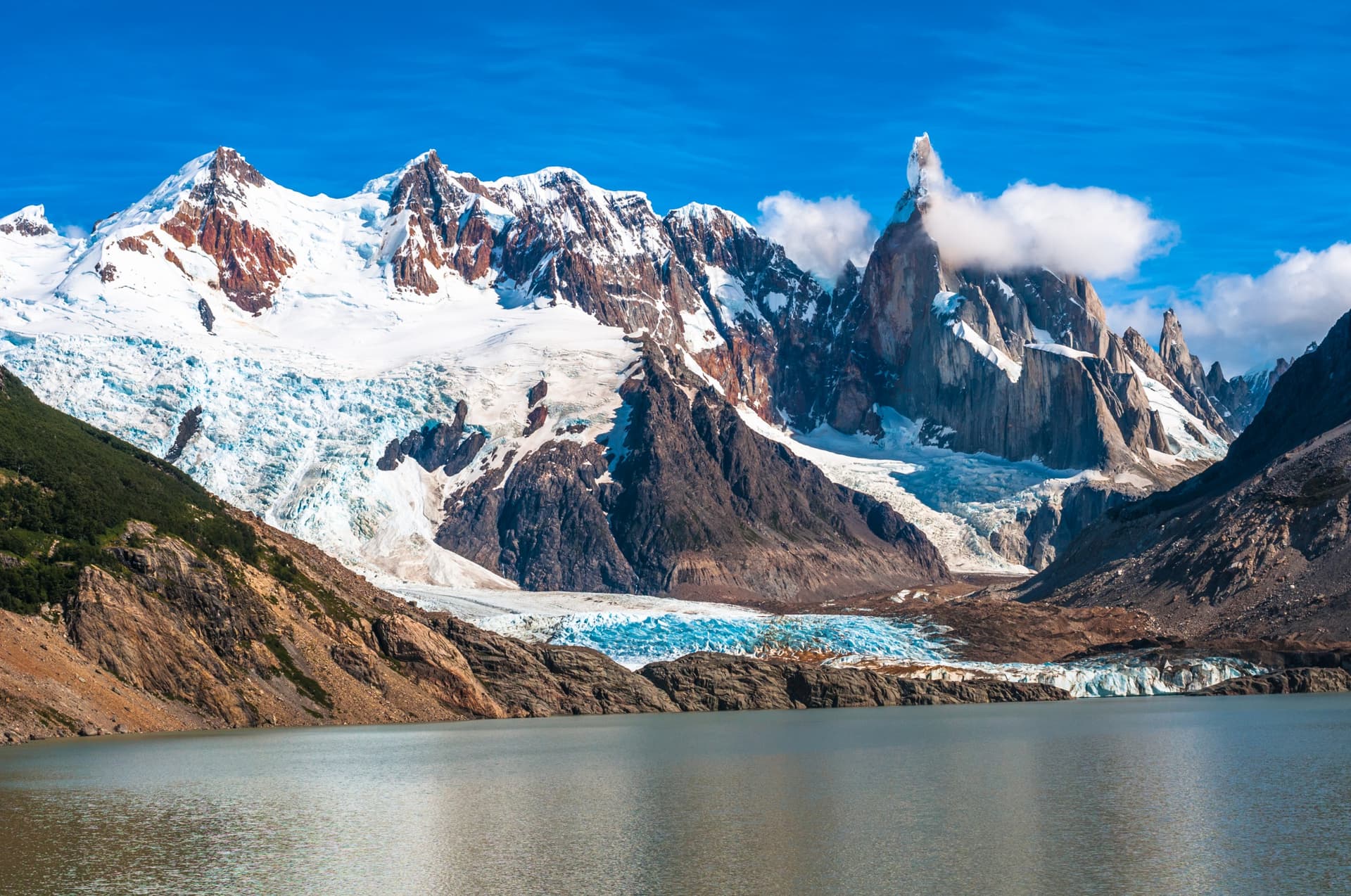
A 3,128 m granite spire within Los Glaciares National Park, Cerro Torre is discovered from El Chaltén via an accessible trek leading to Laguna Torre.
Cerro Torre, located at the remote reaches of Patagonia in Argentina, rises above the southernmost tip of Argentina beneath a sky often heavy with storms in the Los Glaciares National Park. This striking slender summit emerges from the eastern edge of the Patagonian ice cap.
It rises majestically like a colossal granite peak above the Pampas, near the southern tip of South America. At times, the reddish glow of sunrise reflects off Cerro Torre and its satellite summits.
The Patagonian mountain Cerro Torre is not only the most beautiful and most difficult to climb in the world—it is above all a legendary mountain that inspired the most incredible deception in the history of mountaineering. It ranks among the most coveted summits worldwide, particularly among seasoned alpinists, because of its difficult ascents and its long pointed form.
History of Cerro Torre
In 1952, French alpinist Lionel Terray declared that Cerro Torre was impossible to climb. Its walls were too steep and extremely smooth. Meteorological conditions were equally appalling.
The first attempts took place during summer 1957–1958. Summer in the Southern Hemisphere begins in December. There were two Italian expeditions in total, led by Cesare Maestri and Walter Bonatti, known to be fierce rivals. Both ended in failure. The equipment, techniques, and technology of the era made scaling the granite wall virtually impossible.
1959: A First Ascent by Maestri, Contested
In 1959, Italian alpinist Cesare Maestri claimed to have completed the first ascent of Cerro Torre, which peaks at 3,102 meters, after reaching the summit via a route crossing the mountain's east face. His rope partner, experienced Austrian climber Toni Egger, died during the descent due to an avalanche. Maestri himself was rescued by his partner and friend Cesare Fava a few days later at the mountain's base, half buried in snow.
Since then, few voices have questioned this ascent. The first reason relates to the difficulty of the route that Maestri and Egger followed to reach the summit of the Tower. The second reason relates to the absence of photographs or footage proving that Cerro Torre's summit was actually reached.
This first ascent claimed by Maestri with Austrian Toni Egger would rank among the finest achievements in mountaineering history. It was the conquest over 7 days of an extremely difficult summit and a highly technical route, all under adverse meteorological conditions.
1970: The Compressor Route by Maestri
Cesare Maestri's ascent of Cerro Torre faced vigorous criticism in the 1960s. To silence his detractors, Maestri organized another expedition in 1970, accompanied by 5 climbers. He thus established what is now called the "compressor route."
Cesare Maestri attempted the ascent of Cerro Torre once more, this time equipped with a drill and compressor to place pitons in the rock. After a fresh failure in June, he finally reached the rock/ice boundary the following summer, though without reaching the summit ice cap. Seeing Spanish climbers preparing to use the route he had opened with piton assistance, he became enraged and ripped out all pitons on the final section.
The first complete and undisputed ascent of Cerro Torre occurred in 1974. It was accomplished by Casimiro Ferrari, Mario Conti, Daniele Chiapa, and Pino Negri. Unfortunately for them, this feat received minimal media coverage.
1976: The Ascent of Torre Egger by Jim Donini
In 1976, a team of American alpinists made the first ascent of a summit neighboring Cerro Torre: Torre Egger. Located between Cerro Torre and Cerro Standhardt, Torre Egger was named in memory of Maestri's last climbing partner. John Bragg, Jim Donini, and Jay Wilson chose a route that retraced the first half of the Maestri–Egger line.
The 3 alpinists passed through the Conquest Col, situated between Torre Egger and Cerro Torre, then traversed the ridge to the Torre Egger summit. The ascent, slowed by poor weather, was completed from December 1975 to February 22, 1976.
Donini, moreover, disputed Maestri's claim. The latter had described the first section of slab climbing up to the col as easy. The final traversing section, he said, was delicate and difficult.
For Donini, it was the opposite. The slab climbing was difficult, while the traverse to the col was straightforward to accomplish. It followed a hidden ledge process. For Donini, Maestri had not reached the Conquest Col and had not climbed Cerro Torre in 1959.
John Bragg on the Final Ice Mushroom
American climber John Bragg also criticized Maestri's questionable ethics. He is known for making the second ascent of Cerro Torre in January 1977, with Jay Wilson and Dave Carman. They chose to take the Ragni route on Cerro Torre's west face.
1979: Another Ascent of the "Compressor Route"
The second ascent of the "compressor route," which took place in 1979, was accomplished by American climbers Jim Bridwell and Steve Brewer in 3 days. The pair completed the route by climbing virgin granite using rivets, pitons, and copper heads drilled into nascent cracks. The summit was reached on April 1st, 1979.
In 1991, Cerro Torre was the subject of a feature film called "Cerro Torre Grito de Piedra."
On November 13th, 2005, at 11:15 p.m., three experienced climbers also accomplished the feat. They distinguished themselves by reaching the Cerro Torre summit quickly (in 2 days).
In 2012, David Lama became the first alpinist to free climb Cerro Torre entirely, meaning without equipment save for safety gear.
Cerro Torre Today
At Argentina's southern tip, between a vast ice cap and the rolling Patagonian steppes, rises the immense tower of ice and rock standing 3,128 meters tall, called "Cerro Torre." This mountain, one of the most fascinating in the world, harbors numerous controversies and major mountaineering challenges.
Its distinctive silhouette is an icon recognized by the finest and most devoted climbers on the planet. Among access routes are the Argentine city of El Chaltén and the Chilean town of Villa O'Higgins.
Overview of Cerro Torre
Cerro Torre is a Patagonian summit located in the Southern Patagonian Ice Field, approximately 50 km north of Torres del Paine National Park.
For many years, this lofty summit was considered one of the world's most difficult to climb. Not because of its height, but because the final stage of its ascent requires climbing a vertical granite wall for 800 meters before reaching the summit.
Moreover, climatic conditions are extremely variable and winds extremely violent. It is difficult to predict in advance an ascent spanning several days. The summit is covered with a fragile and unstable ice cap—a final substantial challenge in reaching the peak.
Cerro Torre is an incredible Tower of Babel shaped like a rocket, its summit hidden by clouds 300 days per year. It is crowned with enormous ice blocks and frost balanced on abysses, stretching several kilometers.
Cerro Torre is the highest point of a sub-range of mountains generally called the "Torre group." The three other peaks forming the chain are Torre Egger (2,689 m altitude), Punta Herron (2,750 m altitude), and Aguja Standhart (2,700 m altitude).
The Cerro Torre Trek
The Cerro Torre Trek is well-known among hiking enthusiasts. It leads to magnificent Cerro Torre and surrounding mountains. Difficulty is low. The distance is approximately 24 km and can be completed in 5 or 6 hours.
This is a hike that can be done in a single day (round-trip). El Chaltén is both the departure and return point. The trek begins gently with a climb, then a descent through lush forest.
The trail leads to "Laguna Torre". A path on the right side of the lake will allow you to get as close as possible to "Cerro Torre." Also enjoy magnificent views of glaciers situated beneath the rock wall.
Climate
The climate is characterized by a dominant and persistent westerly wind, highly variable precipitation around Cerro Torre, and cold temperatures.
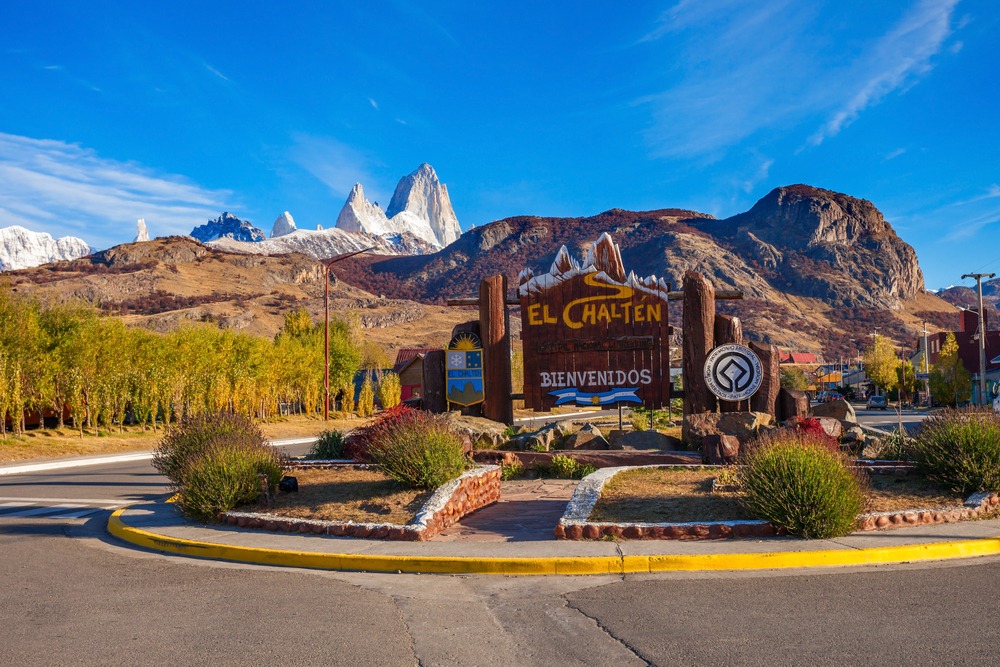
One of the best ways to reach Cerro Torre is to pass through the town of El Calafate, then the locality of El Chaltén.
By Air
There are two possible routes:
- Take a flight from Buenos Aires to El Calafate Airport. Flights are not scheduled daily.
- Take a flight to the city of Rio Gallegos. From there, via regular bus, take national route number 5 (paved), which leads you to El Calafate. The journey of 316 km takes approximately 5 hours.
By Bus
To reach El Chaltén from El Calafate, take Route 11, heading west. From there, turn left heading north, which takes you onto Route 40. Then take Route 23, then turn left, heading west, to arrive at El Chaltén.
Interested in this visit?
We can include it in your personalised itinerary.