Lago Argentino
Lago Argentino
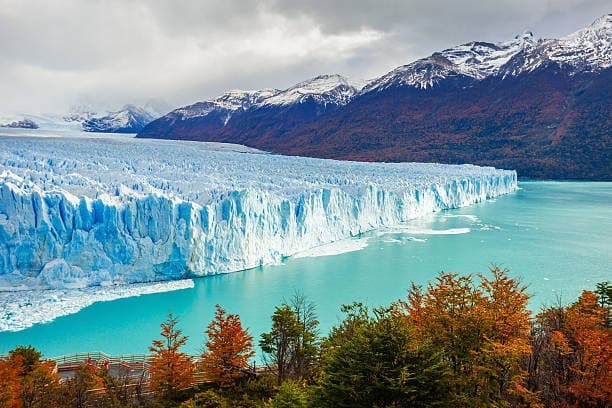
South America's third-largest lake, Lago Argentino borders El Calafate and provides access to the Perito Moreno, Upsala and Spegazzini glaciers.
Venture into the wild splendor of one of Argentina's most magical corners: Lago Argentino. Let yourself be captivated by its unparalleled natural richness. It stands as a centerpiece of the region's glacial landscape. Its privileged location within Los Glaciares National Park makes it an unmissable attraction for travelers seeking exceptional panoramas and biodiversity. Embark on a boat excursion to get up close to the icebergs.
A Brief History
Lago Argentino formed approximately 15,000 years ago. In 1873, sailor Valentin Filberg visited and did not name it, believing it was Lago Viedma, discovered in 1782. Four years later, Francisco Moreno and Carlos Moyano confirmed it was a different lake and named it "Argentino" on February 15, 1877.
Lago Argentino: An Idyllic Destination to Explore in Patagonia
Geographic Setting and Area
Located in Santa Cruz Province in Argentina, in the heart of Los Glaciares National Park, Lago Argentino ranks as South America's third-largest lake and constitutes a vast freshwater reserve. It spans a total area of 1,415 km² and sits at 178 meters altitude near El Calafate. As a major feature of Argentina's Patagonian landscape, this sanctuary stretches 125 km long, 14 to 20 km wide, and reaches depths between 35 and 1,000 meters.
Water Sources and Ecosystem
This aquatic basin is fed by glacial meltwater from several rivers, including those from Lago Viedma via the La Leona River, and by numerous mountain streams. Its watershed exceeds 17,000 km², and its waters flow into the Atlantic Ocean via the Santa Cruz River. Its main body and arms such as Upsala, Norte, Rico and Sur are crossed by the Iceberg Canal opposite the Perito Moreno glacier. With a basin of 15,500 km² including Lago Viedma, it offers an exceptional natural vista.
A Palette of Colors
The lake's waters captivate the eye with their gray-blue hue, a palette that shifts delicately along the Upsala and Norte arms. Before reaching the lake's main body, most sediment particles settle to the bottom, revealing a deeper shade of blue.
Situated in the heart of majestic glaciers, Onelli Bay contrasts with strikingly gray water. This singular color originates from "glacial milk," composed of fine particles resulting from glacier abrasion. The colors of these clear waters change depending on depth, the amount of suspended particles, and particle size.
Excursion on Lago Argentino
Glaciers and Activities
Surrounding glaciers such as Perito Moreno and Upsala enhance the lake's landscape and serve as focal points for boat excursions.
Navigating this lake offers panoramic views of the Upsala and Spegazzini glaciers, as well as Onelli Bay, dotted with icebergs. An excursion departing from Puerto Bandera crosses the Iceberg Canal and explores the Upsala, Norte and Rico arms.
Once there, you'll notice this body of water is a habitat for various fish species. This makes the area attractive for fishing. Other activities around the lake include exploring the nearby town of El Calafate, renowned for its glaciers and fishing opportunities.
Encountering Wild Fauna
Lago Argentino is the privileged residence of two predominant fish species: the Puyen and the Perch.
Expect also to encounter gentle foxes, which have been reported in the region since the 1990s.
A Visit to Los Glaciares National Park
This sanctuary owes its name to its glacial coverage, which occupies half its surface. Imagine a landscape where snow reigns in the west and the Patagonian steppe stretches to the east. It nurtures no fewer than 47 glaciers, of which 13 descend from the Argentine side toward the Atlantic. Add to this over 200 independent small glaciers, lakes formed by glacial melt, and two emblematic peaks: Cerro Torre rising to 3,102 meters and Fitz Roy at 3,375 meters.
What makes this glacial ensemble truly special is its relatively low altitude. Indeed, the glaciers do not exceed 1,500 meters.
During a getaway, you'll have the chance to observe a multitude of birds. From the Condores viewpoint, the majestic condor offers a captivating aerial spectacle. Along the way, you'll encounter the white-throated caracara, the Magellanic woodpecker, the black-chested eagle-buzzard, the chucao, various songbirds like the Chingolo and the austral pygmy-owl. And keep a vigilant eye, as the huemul deer may occasionally appear in these lands.
Weather at Lago Argentino
The region has a cold semi-arid climate with cool to warm, dry summers and cool to cold, slightly more humid winters. Lago Argentino moderates temperature extremes. In winter, the bay near town often freezes, offering residents the opportunity for ice skating.
Weather is marked by frequent showers throughout the year, even during the driest months. The average annual temperature is approximately 4.9°C, with average precipitation of 765 mm per year.
Nearby Attractions
- Lago Viedma
- Lago Saint-Martin
- Puerto Bandera
- Spegazzini
How to Get There
From Buenos Aires, take a flight lasting approximately 5 hours. Fares range from $75 to $750.
Comandante Armando Tola International Airport also connects El Calafate and Lago Argentino via numerous domestic and international flights.
Interested in this visit?
We can include it in your personalised itinerary.